If you’re planning a flat roof installation or refurbishment, one of the first decisions you’ll face is how the roof will be insulated.
Traditionally, the choice came down to two options: warm flat roofs and cold flat roofs.
While both systems still exist, building standards, materials, and expectations have evolved significantly. What was once common practice is no longer always recommended—particularly when it comes to cold roof construction.
Today, warm flat roofs are widely considered the preferred solution, not just for performance, but for compliance with modern UK Building Regulations.
Understanding why requires looking beyond the basics and focusing on how these systems actually perform in real-world conditions.
What Is a Warm Flat Roof?
A warm flat roof is designed so that the insulation sits above the structural deck, keeping the entire roof structure at a similar temperature to the interior of the building.
This approach reduces temperature differences within the roof build-up, which is key to preventing condensation and improving overall thermal performance.
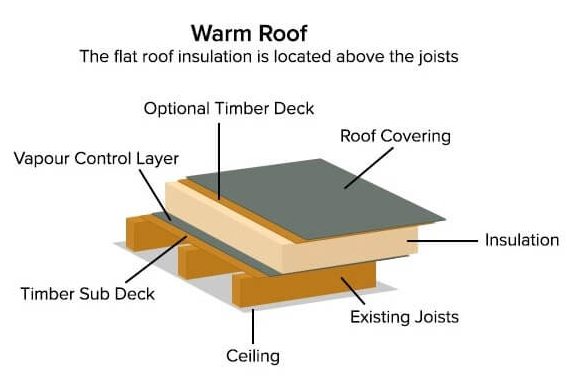
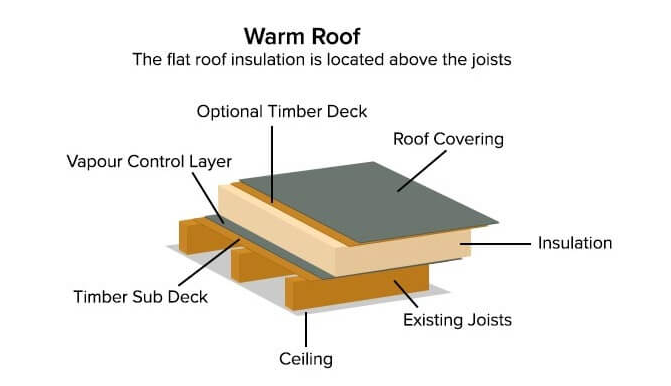
Modern Warm Roof Build-Up
A compliant warm flat roof typically follows this structure:
- Structural deck
- Vapour Control Layer (VCL)
- Rigid insulation (typically PIR)
- Waterproof membrane
This layering is critical. Each component plays a specific role, and incorrect sequencing can compromise performance.
Why Vapour Control Layers (VCL) Are Now Essential
One of the biggest changes in modern warm roof construction is the mandatory inclusion of a vapour control layer.
The VCL is installed directly above the deck and below the insulation.
Its purpose is simple but critical:
- Prevent warm, moisture-laden air from entering the roof structure
- Reduce the risk of condensation forming within the build-up
In today’s standards, a VCL must be continuous and properly sealed, with particular attention paid to penetrations such as lighting or services.
Without it, even a well-insulated roof can develop long-term moisture issues.
What Insulation Is Required for Warm Roofs Today?
Older guidance often referenced minimal insulation levels. That is no longer acceptable.
Modern warm roofs typically use:
- 120–200mm PIR insulation (or equivalent materials)
This is designed to meet current Part L Building Regulations, with target U-values generally in the range of:
- 0.11–0.18 W/m²K
These improved standards reflect a wider push toward energy efficiency and reduced heat loss in buildings.
Why Warm Roofs Are Now the Preferred Solution
Warm roofs are no longer just an option—they are often the recommended approach for new builds and refurbishments.
This is largely due to their ability to meet modern performance requirements more reliably.
They offer:
- Improved thermal efficiency
- Reduced risk of condensation
- No requirement for complex ventilation systems
- Better control of airtightness
- Reduced thermal bridging
By keeping the structural elements warm, the system avoids the temperature differences that typically cause problems in cold roof designs.
The Role of Airtightness and Condensation Control
Modern roofing design places a strong emphasis on airtightness and condensation management.
In warm roof systems:
- Thermal bridging is minimised
- Moisture movement is controlled through the VCL
- Internal humidity is less likely to affect the structure
This is particularly important in modern homes, where increased insulation and reduced natural ventilation mean moisture levels can build up more easily.
Warm roofs are designed to manage this effectively.
Fire Performance and Compliance
Another important consideration in modern roofing is fire safety. Warm roof systems should meet current UK fire performance standards, such as:
- BROOF(t4) classification
This ensures that the roof covering system resists external fire spread, an essential requirement for compliance and safety.
What Is a Cold Flat Roof?
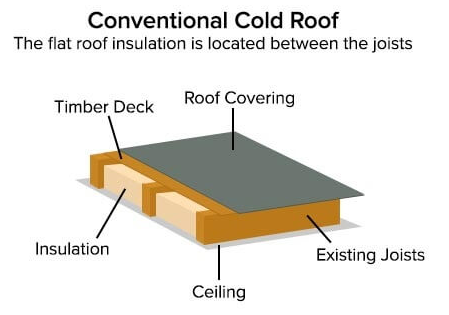
A cold flat roof places insulation between or below the rafters, leaving the roof deck and structural elements exposed to colder external temperatures.
This creates a temperature difference within the roof structure, which is where problems can begin.
To compensate, cold roofs rely heavily on ventilation.
Why Cold Roofs Are Less Common Today
Cold roof designs were once widely used, but they are now far less common in modern construction.
The main reason is their reliance on perfect ventilation, which is difficult to achieve consistently.
To function correctly, a cold roof requires:
- Adequate airflow above the insulation
- Continuous ventilation paths
- Precise detailing to avoid trapped moisture
In practice, even small installation errors can lead to condensation forming within the roof structure.
Over time, this can result in:
- Damp
- Timber decay
- Reduced insulation performance
Because of these risks, cold roofs are generally not recommended for new flat roof builds under current standards.
Are There Any Situations Where Cold Roofs Are Still Used?
Cold roofs may still be used in certain refurbishment scenarios, particularly where altering the roof height is not practical.
However, they require careful design and execution.
Even then, many projects now aim to convert existing cold roofs into warm roofs wherever possible.
Key Differences Between Warm & Cold Flat Roofs
The difference between the two systems comes down to how they manage heat and moisture.
Warm roofs:
- Keep the structure warm
- Control moisture with a VCL
- Do not rely on ventilation
- Meet modern energy standards more easily
Cold roofs:
- Leave the structure cold
- Depend on ventilation to remove moisture
- Are more prone to condensation issues
- Are less aligned with current building practices
What Do UK Building Regulations Require?
Modern flat roof construction must comply with several parts of the UK Building Regulations, including:
- Part L (Energy efficiency)
- Part C (Moisture control)
- Part B (Fire safety)
Warm roof systems are generally better suited to meeting these requirements due to their design and performance.
Which Option Is Right for Your Project?
In most cases, a warm flat roof will be the preferred and recommended solution.
It aligns with current standards, offers better long-term performance, and reduces the risk of common roofing issues.
Cold roofs, while still technically viable, require a level of precision and ventilation control that makes them less practical for modern builds.
Frequently Asked Questions (FAQs)
What is the main difference between a warm and cold flat roof?
A warm roof places insulation above the deck, while a cold roof places it below, leaving the structure exposed to colder temperatures.
Are cold flat roofs still allowed in the UK?
Yes, but they are less commonly used and not typically recommended for new builds due to ventilation challenges.
What insulation is used in modern warm roofs?
Typically, 120–200mm PIR insulation or equivalent, designed to meet current Part L U-value requirements.
Conclusion
The way flat roofs are designed and constructed has changed.
What was once considered standard practice—particularly with cold roof systems—has been reassessed in light of modern living conditions, higher insulation standards, and stricter regulations.
Warm flat roofs now represent the most effective approach for most projects, offering improved thermal performance, better moisture control, and easier compliance with UK Building Regulations.
If you’re planning a new flat roof or upgrading an existing one, understanding these differences is key to making the right long-term decision.